Bachelor thesis, Leipzig 2022 · remodelled
cloud physics · stochastic collection · numerical methodsDroplet Collection
How cloud droplets become rain
A large drop falls faster than a small one and sweeps it up; that is how a cloud of tiny droplets can turn into rain within minutes. Numa Koudsie’s Bachelor thesis, Collisional Ice Multiplication Processes in Clouds (Leipzig, 2022), modelled this collection and the ice splinters it can produce, with Stokes’ law for the fall speed and the geometric cross-section for the chance of a hit. The remodel replaces each ingredient with physics that holds at the sizes that matter: a drag balance for the fall speed, collision efficiencies from the trajectory of the small droplet in the air flow around the large one, and the full stochastic collection equation for the bookkeeping. Every step is derived on the theory page and tested on the checks page, and the solver runs in your browser.
- 6 / 14 min
- to 50 / 90 % of the mass above 40 µm, extended kernel
- 3 / 5 min
- the same, thesis kernel
- 2.1 %
- largest fall-speed error against measurement, from 0.3 mm up
- 10−7
- mass error against Golovin’s exact solution
1.1The warm cloud
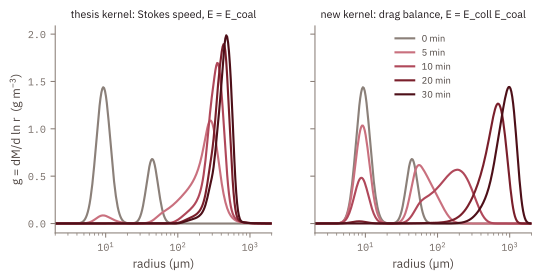
The test case is a warm cloud of \(300\ \mathrm{cm^{-3}}\) droplets of radius \(8\ \mathrm{\mu m}\) with \(1\ \mathrm{cm^{-3}}\) collectors of \(40\ \mathrm{\mu m}\), at \(10\,{}^{\circ}\mathrm{C}\) and \(850\ \mathrm{hPa}\). Growth is measured by the mass fraction in drops of radius \(r \ge 40\ \mathrm{\mu m}\): a diagnostic of growth, not a rainfall prediction. With the thesis kernel the mass piles up near \(500\ \mathrm{\mu m}\) and stops, because the Weber number computed with Stokes speeds switches coalescence off; with the extended kernel the drops keep growing to millimetres. The kernel matters more than the bookkeeping.
1.2What changed, one line each
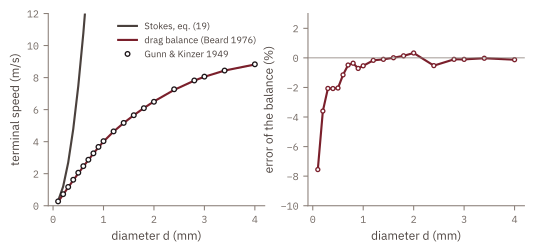
- Fall speed. Stokes’ law gives \(\mathrm{Re}\approx 150\) for a \(200\ \mathrm{\mu m}\) drop, outside its own validity. A force balance with Beard’s drag coefficient \(C_D(\mathrm{Re})\), solved through the Davies number, reproduces the measurements of Gunn and Kinzer within 2.1 % from 0.3 mm up.
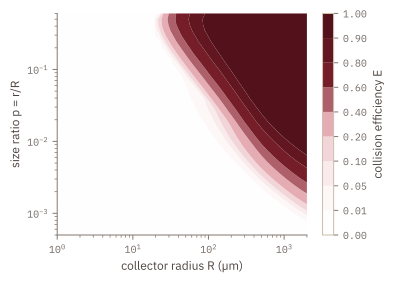
- Collision efficiency. The small droplet obeys \(\tau\,\dot{\mathbf v} = \mathbf u - \mathbf v - \tau g^{*}\mathbf e_z\) in the flow around the collector; scaled by \(R\) and \(U\) this is the Stokes number \(\mathrm{St} = \tau U/R\). The grazing trajectory gives \(E\); the solver reproduces the critical Stokes numbers \(1/12\) and \(1.21\).
- Bookkeeping. The thesis’s two fixed populations become one spectrum obeying the Smoluchowski collection equation; the thesis equations are recovered as its limit of rare collectors.
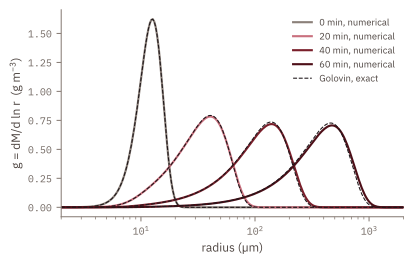
- Numerics. A logarithmic mass grid, pair fluxes computed in place, a deposit that conserves number and mass, and a limiter that is derived rather than guessed; tested against Golovin’s exact solution, with a mass error of \(10^{-7}\) and a spectrum error of 5 % at 8 bins per doubling.
- Ice. Splinter fragments join the interacting population. The app’s fragmentation is event-based: a fixed mass fraction \(\lambda\) per ice–ice collision and a fixed fragment mass. The thesis’s code drains mass at a random rate per second instead, so the cold runs test the app’s closure, not the thesis’s model. With fragments in the race the ice number grows from 167 to 1 700–2 100 cm⁻³ in an hour and the mass above 40 µm falls to 0.2–4 %: the closure, not the solver, drives that result.
1.3Four figures from the project
1.4The project’s own pages
- OverviewThe question, the warm cloud in two pictures, and the droplets falling.
- TheoryTwelve chapters from the encounter to the evidence map, 62 numbered equations, worked examples, and each correction where it occurs.
- ResultsWarm and cold clouds, four models of the same spectrum.
- SimulateThe solver of the collection equation, in your browser.
- ChecksFall speed, collision efficiency, critical Stokes numbers and the Golovin test.
A static copy of the Droplet Collection app. Its saved-runs list is left out: every run is computed fresh in your browser, and nothing is stored.